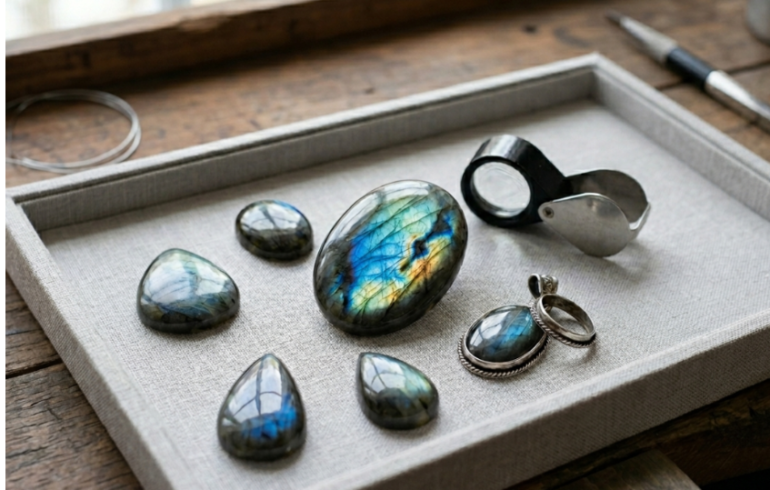
If you’ve ever seen a labradorite cabochon, you know how it looks. At first glance, it just looks like an ordinary grey stone. But tip it a bit, and you will see flashes of blue, green, and gold. That’s the whole reason people usually shape labradorite into cabochons. These smooth, rounded cuts highlight those colors way better than faceted cuts ever could.
Still, not all labradorite cabochons are born equal. Some shine no matter how you hold them, but others stay dull, maybe a hint of color here and there. So when you want to buy labradorite online this blog will help you, we will tell you what to look for when getting this gemstone.
What is a Cabochon?
Generally, gemstones are cut into flashy angles or sharp edges. But a cabochon cut refers to when a stone has a smoothly rounded top shape. It is flat on the bottom and looks like a tiny dome. The surface is polished and sleek, nothing faceted. For gems like labradorite, this shape really does wonders. The light slides right across the top and shows off those cool flashes.
These cabochons are used mainly for jewelry making. But, some people also use cabochon stones in their healing practices. Some even keep these stones under their pillow to support sound sleep. The cabochon cut makes these stones smooth and easy to use.
The Flash of a Labradorite
If you’re going to pay attention to anything, let it be the flash. There are many reputable websites like Gemstones for Sale, which are known for real labradorite stones. When you shop from such top sellers, quality becomes a default. When checking the flash, look for the amount of shimmer and how many hues the stone has. This effect is technically called labradorescence. It is what makes labradorite so appealing to the masses. When you’ve got a quality cabochon, you’ll see bold, lively flashes of color jumping out at you.
The color should pop, even under regular light. If the stone needs special lightning tricks, then it signifies low quality. Ideally, the flash should dance as you move the stone, and not just from one narrow angle. You should be able to see that glow across most of the surface, not just a small patch.Sometimes, you’ll find labradorite that only shows color when you get the angle just right. Honestly, that’s not what you want. A great piece looks almost electric, like it’s got a pulse as soon as you move it. That’s the sign of the real deal.
Color Quality
Blue grabs all the attention in labradorite, and yeah, it’s stunning. That electric blue flash is hard to beat. Still, there are more colors to see. Labradorite can also pop with flashes of green, gold or yellow, or a whole mix of colors. There are also multicolored stones with a spectrolite look. These are real showstoppers and a bit harder to find. They usually cost more as well.
But when it comes down to it, the best color is the one that catches your eye. Don’t worry about what’s trending. Go with what you actually love. If you want to get a labradorite for jewelry, then consider the metal choice also. Then pick what color would go with the metal you have selected. If not, then simply think about the vibe you want to create with labradorite jewelry.
Surface Finish
With cabochons, there aren’t any facets to catch the light. So the surface itself does all the work. That means the finish really matters here. A top-notch labradorite cabochon shows off a smooth, almost glassy polish. There are no scratches, no pits, nothing to distract from the color. The dome should be nicely curved without any weird bumps or flat spots.
If the surface feels rough or looks uneven, the flash loses its punch and the whole stone just falls flat. You don’t have to see the stone in person to spot this. You can simply zoom in on photos and you can usually pick up on these details right away.
Shape and Symmetry
Shape and symmetry really make a difference with cabochons. They come in all kinds of shapes, such as ovals, rounds, teardrops, and those freeform ones too. Sure, shape is mostly about what you like, but symmetry’s the secret thing that can elevate the whole look.
When a cabochon’s cut just right, it looks balanced, no matter which way you turn it. It fits neatly into its setting and brings out the stone’s natural flash. But if it feels a little off or lopsided, the whole piece can look awkward. It can even make setting the stone trickier.
Final Words
Buying labradorite online is easy, but you can’t really see the stone’s movement on a screen. So, you should ask the seller for videos instead of just photos. Make sure you see how the stone looks in natural light. Always read the reviews before you trust a seller. If you’re shopping in person, slow down and take your time. Tilt the stone, turn it, really look at how the flash appears and disappears.